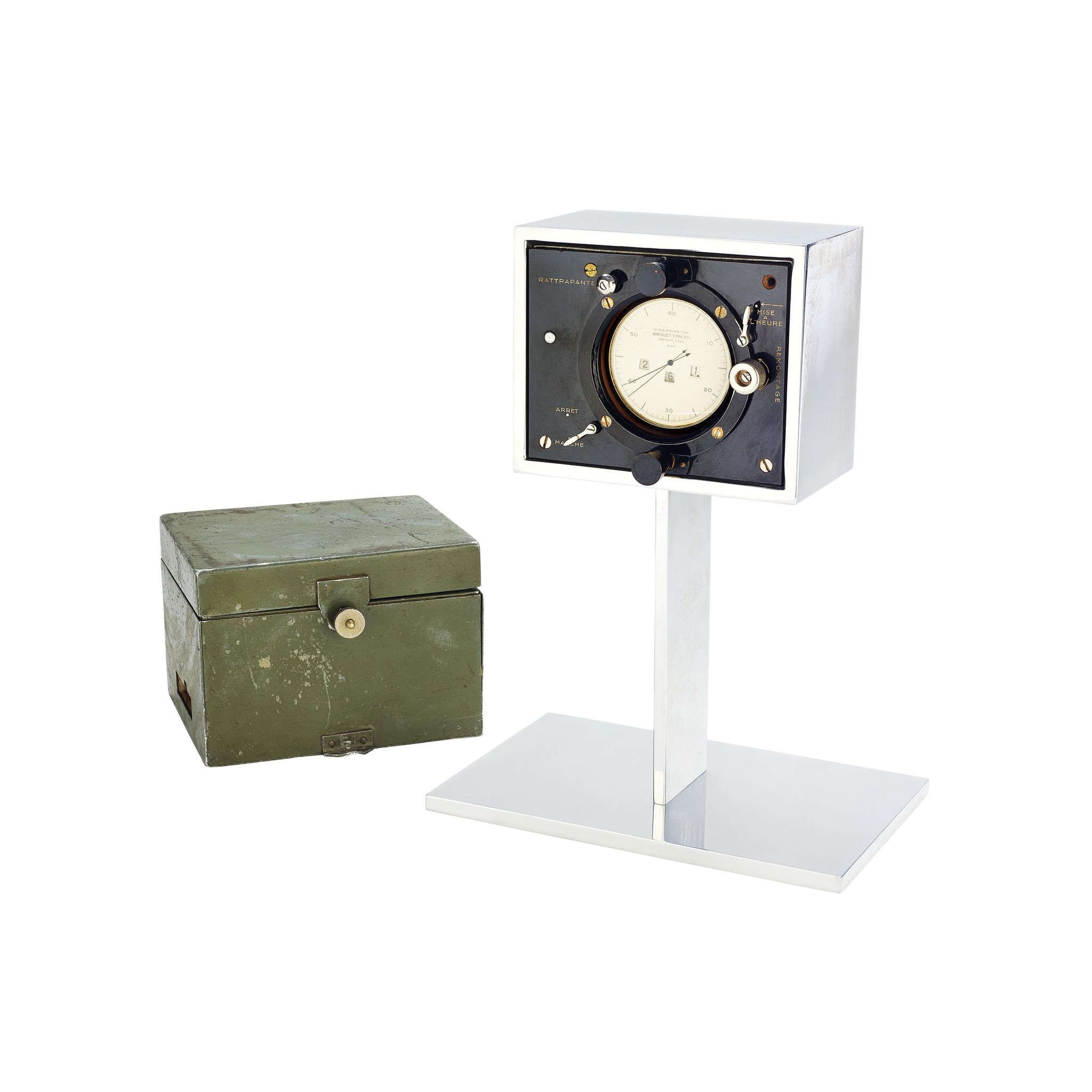
Made in 1938, the Sidéromètre was built to solve one problem for the navigator of a fast aircraft: how to fix a position by the stars before the aircraft has moved too far for the answer to matter. A star sight locates the navigator only if he also knows exactly how far the Earth has rotated at the instant of observation. That figure is an angle, but a clock gives time — so the navigator had to convert one into the other by table, arithmetic that costs minutes at the chart table. In a fast aircraft, those minutes are the difference between a fix and a guess.
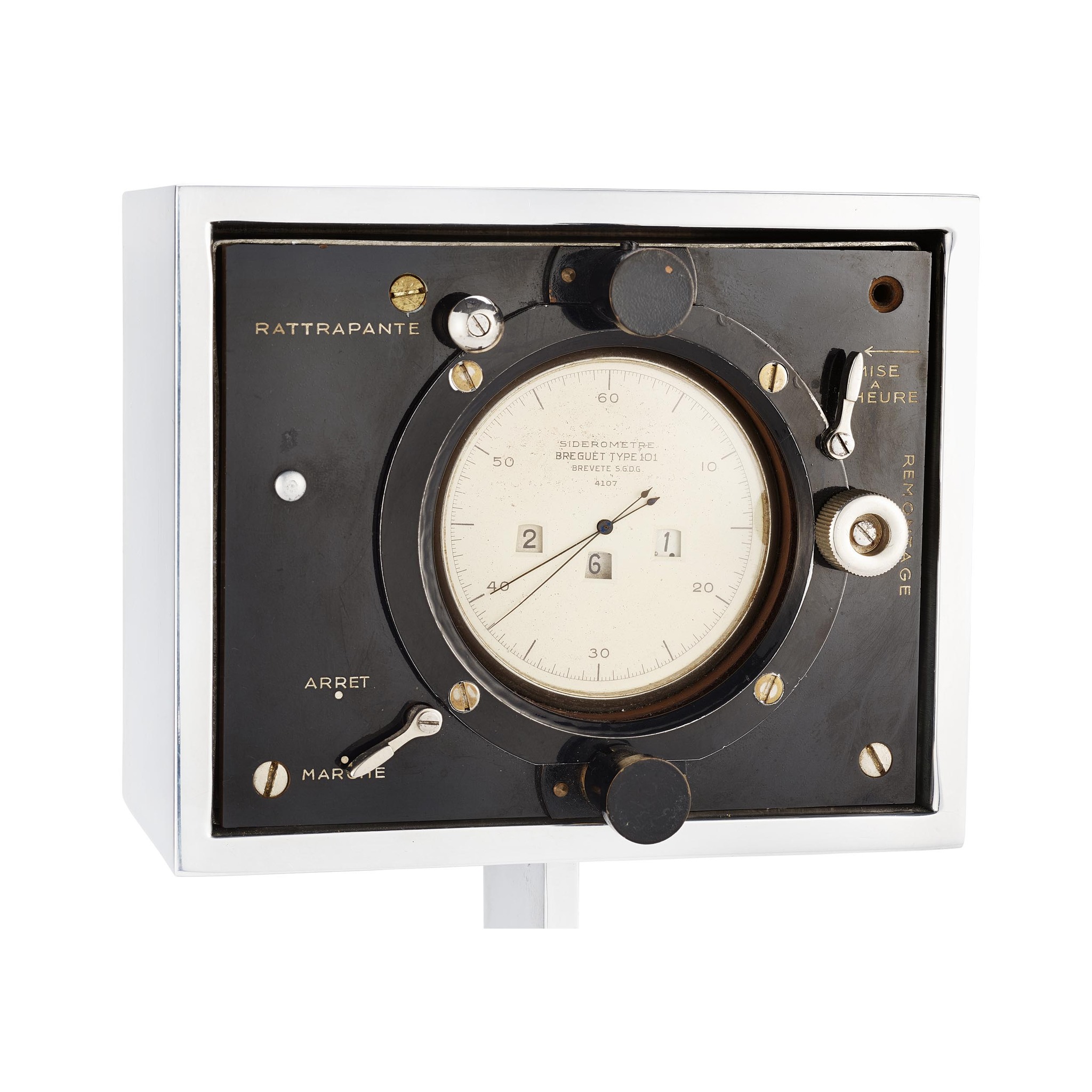
The Sidéromètre removed the conversion. It runs on sidereal rather than mean time and displays the result directly as an angle: the Earth's rotation in degrees, minutes and seconds. The three apertures read degrees at the right, tens at the centre, hundreds at the left, while the centre-seconds hand completes one revolution in the time the Earth turns through a single degree against the stars. The navigator read the number straight off the dial. The split-seconds mechanism froze that reading at the exact moment of the sextant shot while the instrument kept running, so a series of sights could be taken without ever stopping the clock.
The series ran to twenty-five pieces only. This example, No. 4107, was produced in September 1938 and sold to the French Aéronautique on 30 December 1938 for 15,800 francs, an extraordinary sum for a single instrument and a measure of the value the French air arm placed on celestial navigation on the eve of war. The patent was filed in 1939.
By this date the Breguet horological house had long since passed out of the founding family's hands. The descendants of Abraham-Louis Breguet turned progressively toward electricity and later aviation, and in 1870 Louis-Clément Breguet ceded the watchmaking branch to his workshop foreman, Edward Brown, whose family held the Maison for a century. Breguet remained largely out of view through the 1940s — the Type XX dates only from 1954 — which makes the Sidéromètre one of the most unusual objects the name produced in the twentieth century.
With twenty-five made and an unknown number surviving, this is among the rarest categories of twentieth-century Breguet, and it sits at an unusual intersection of collecting fields: horology, the history of celestial navigation, and French military aviation of 1939-40.