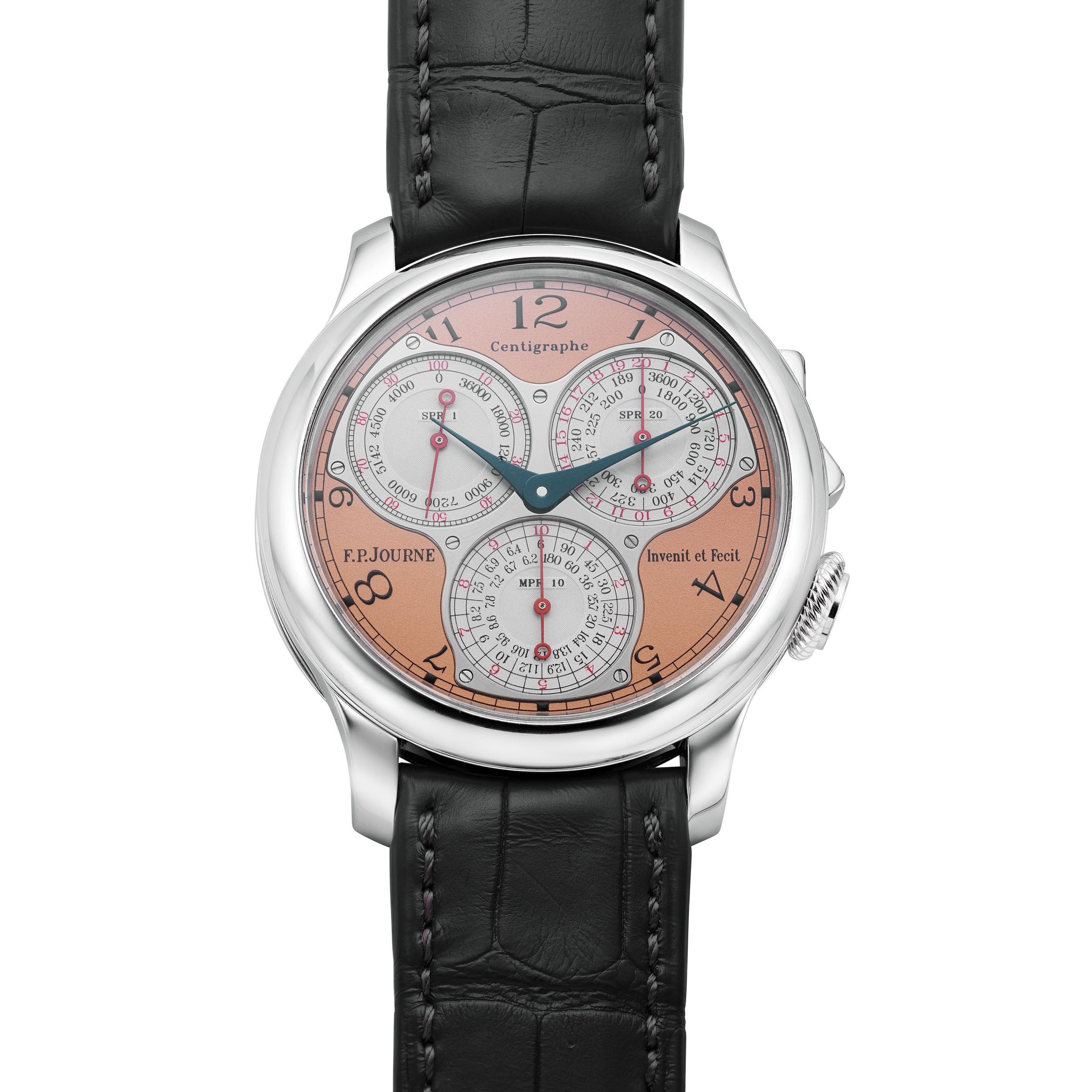
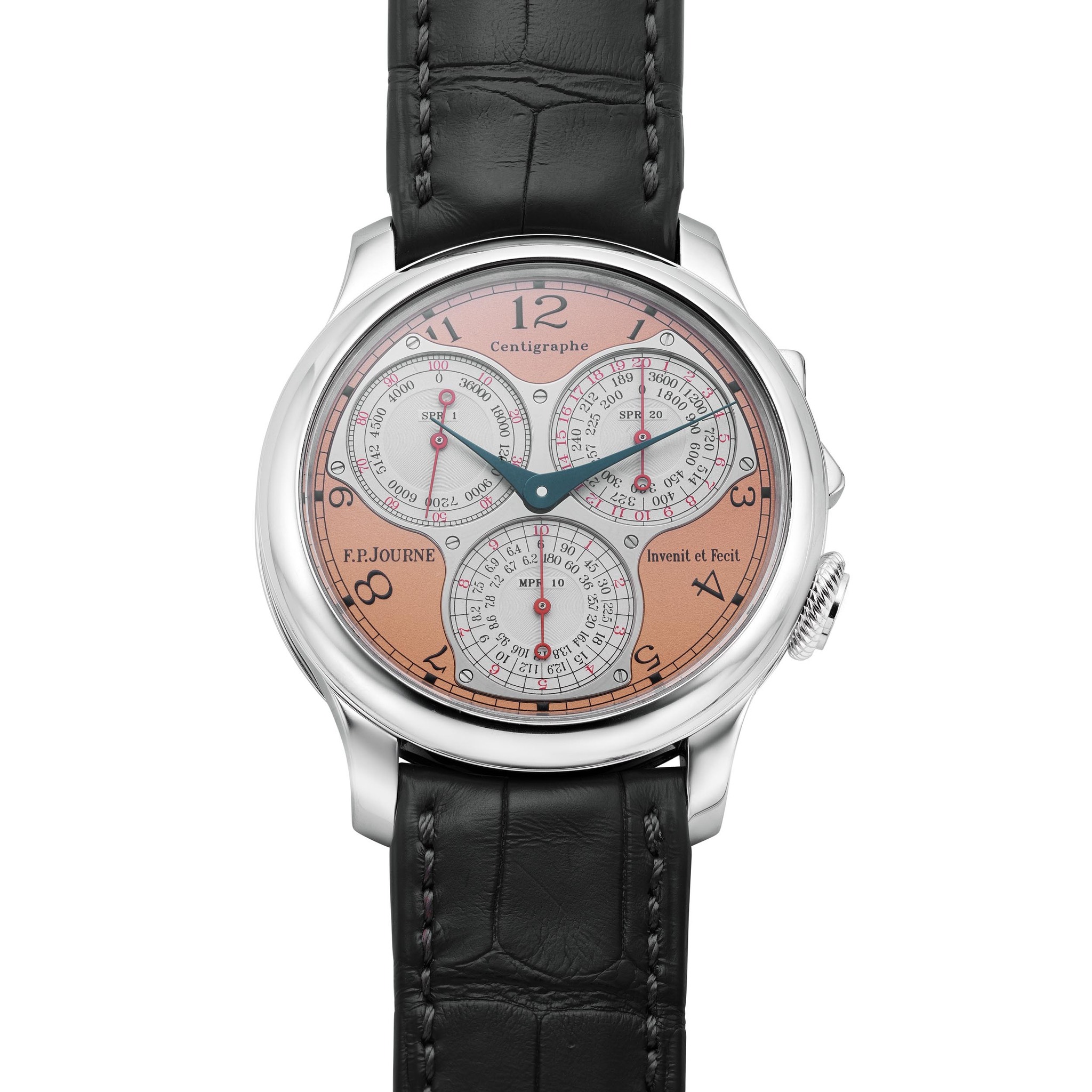
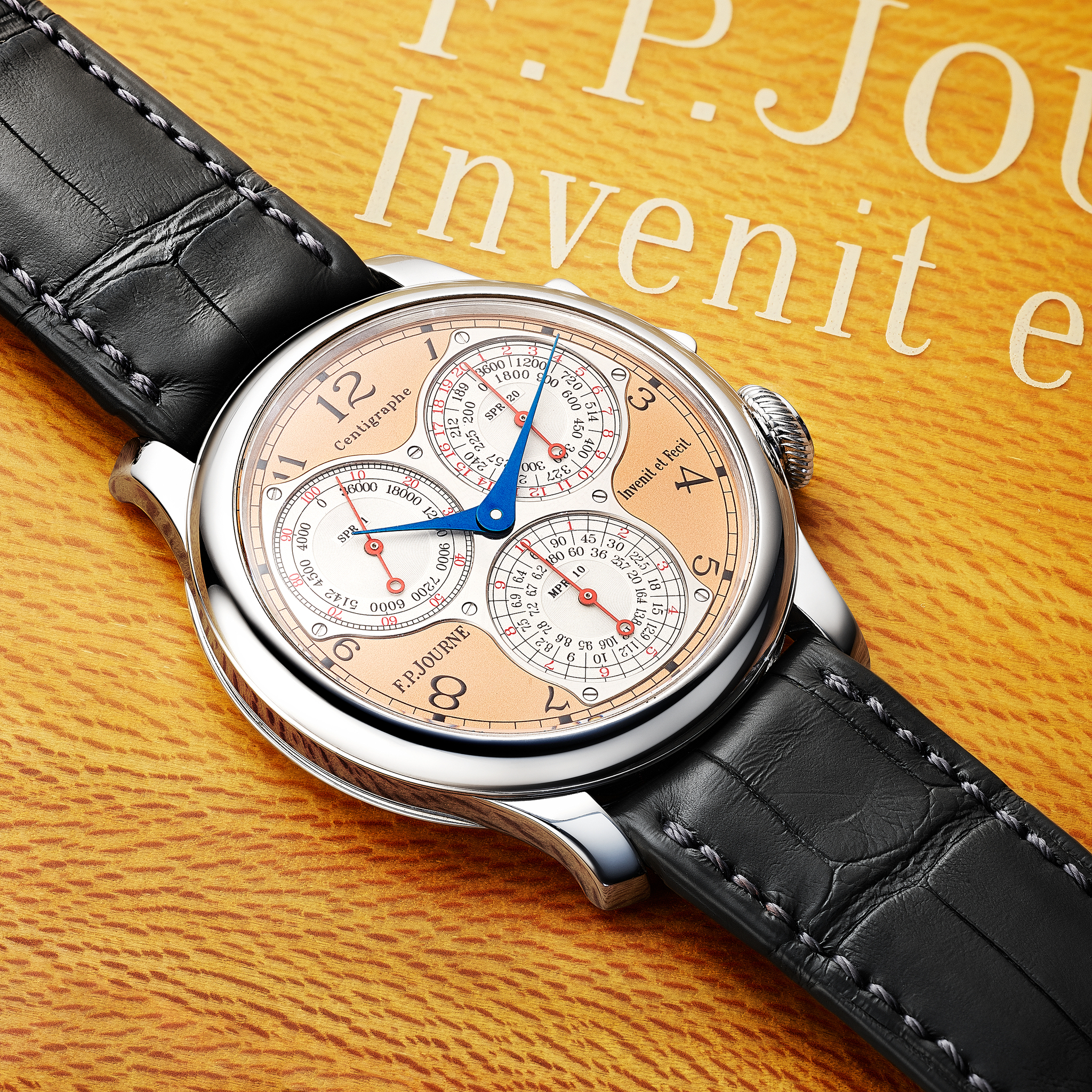
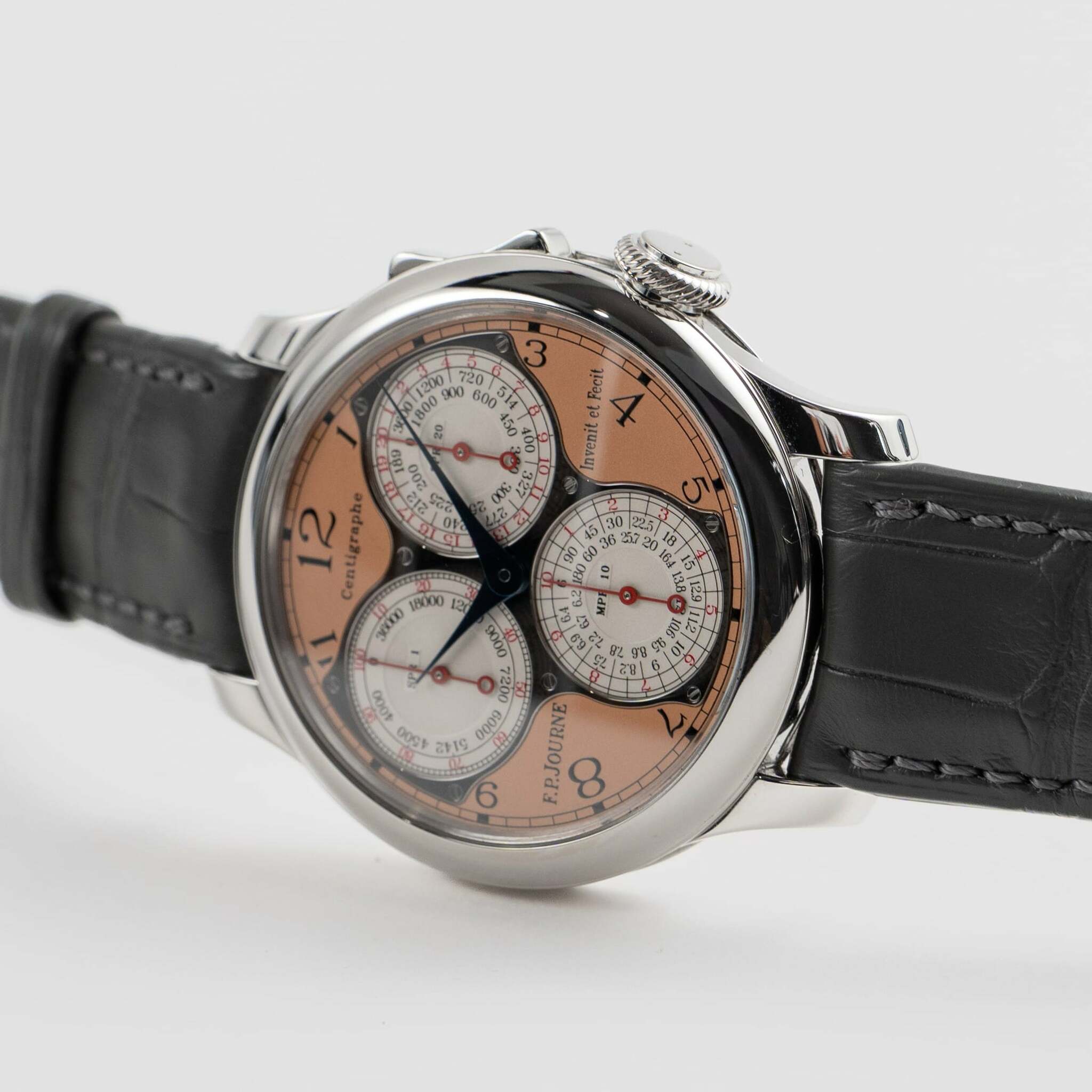
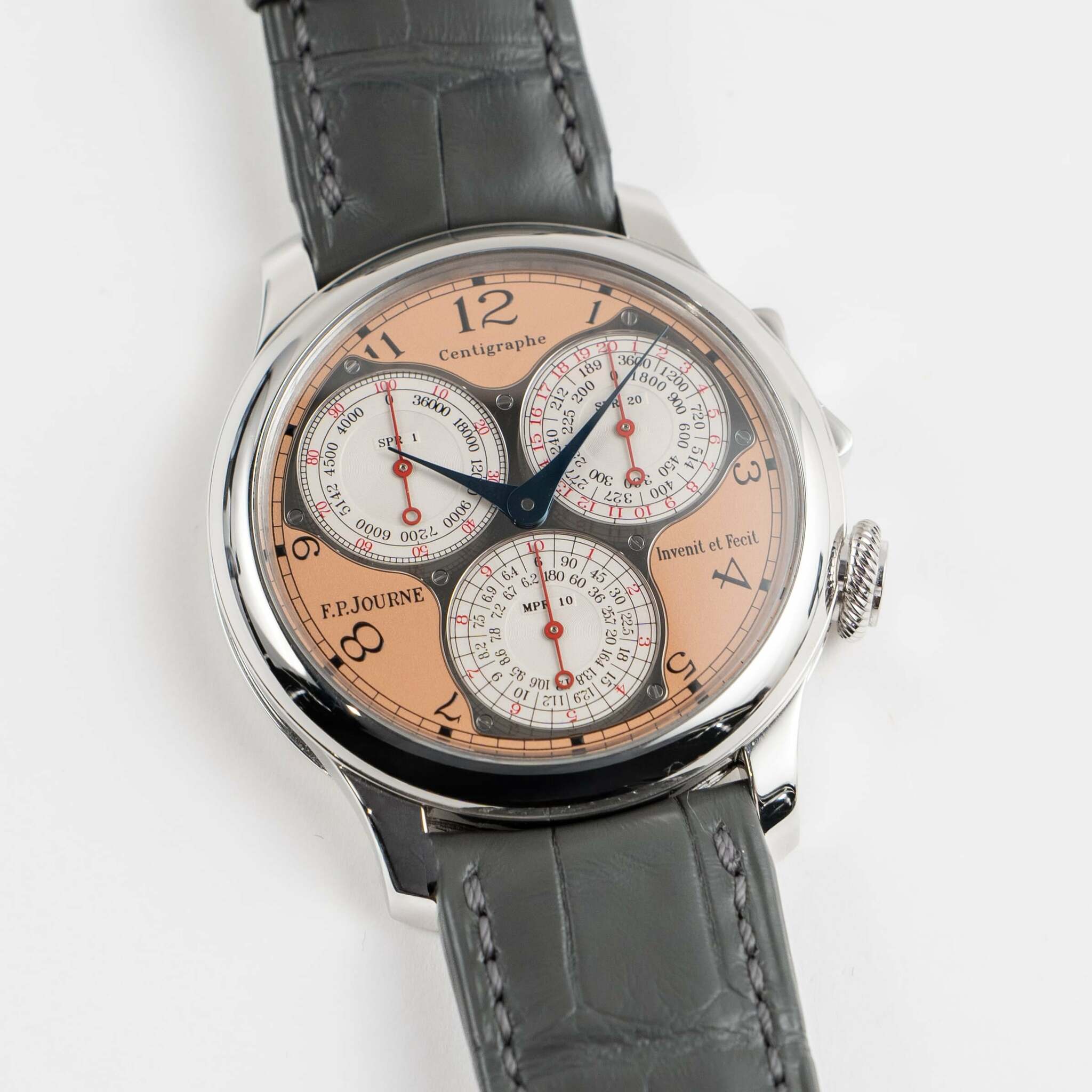
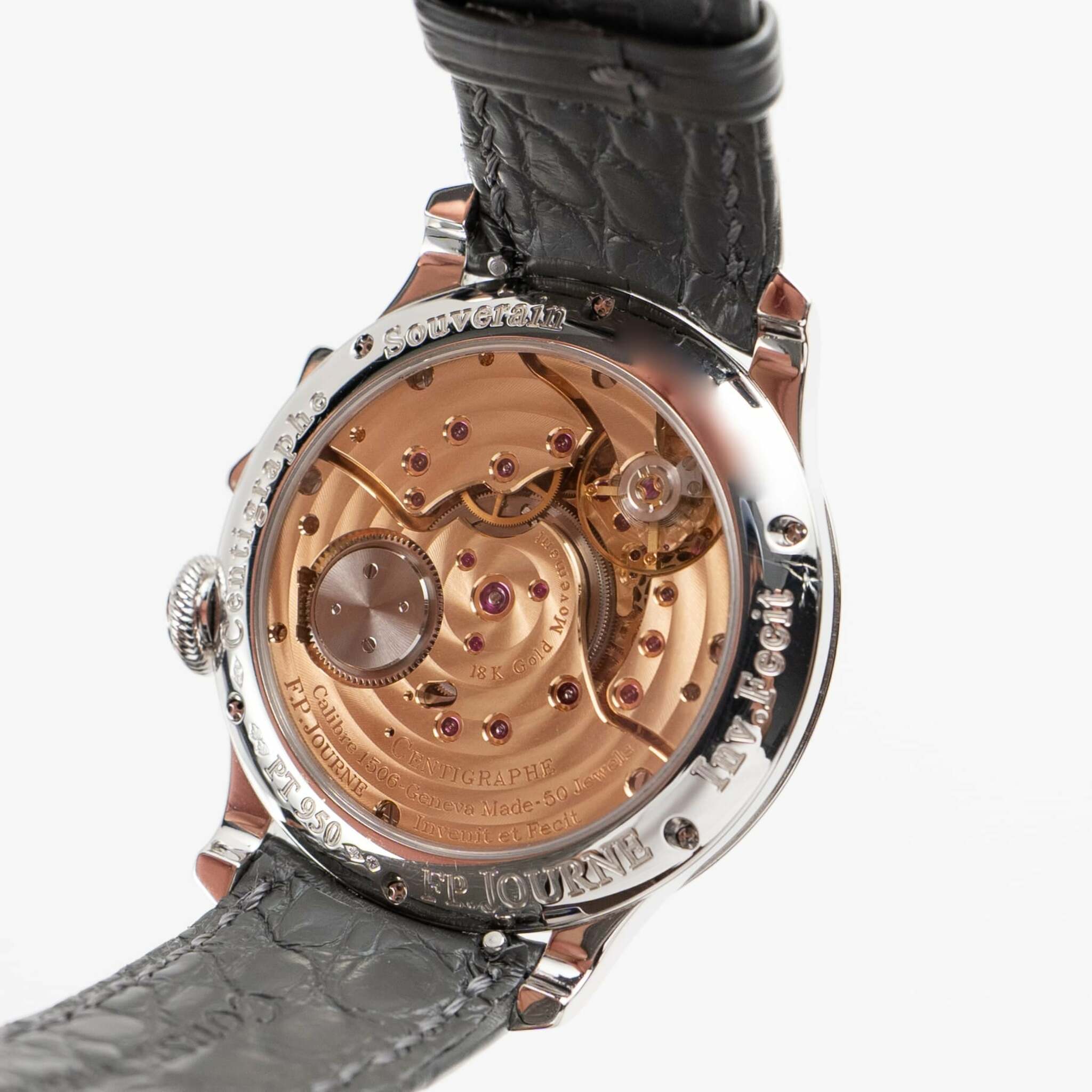
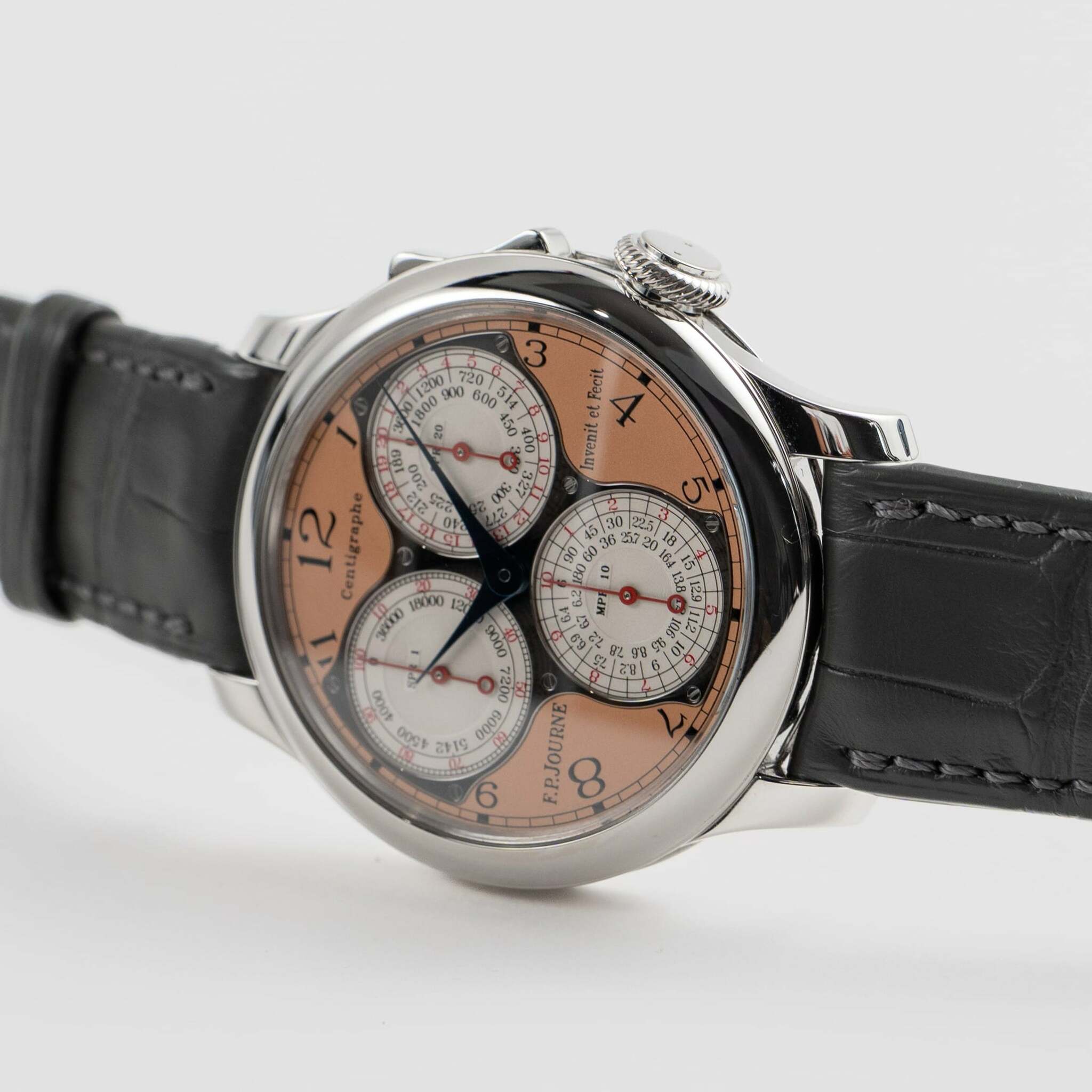
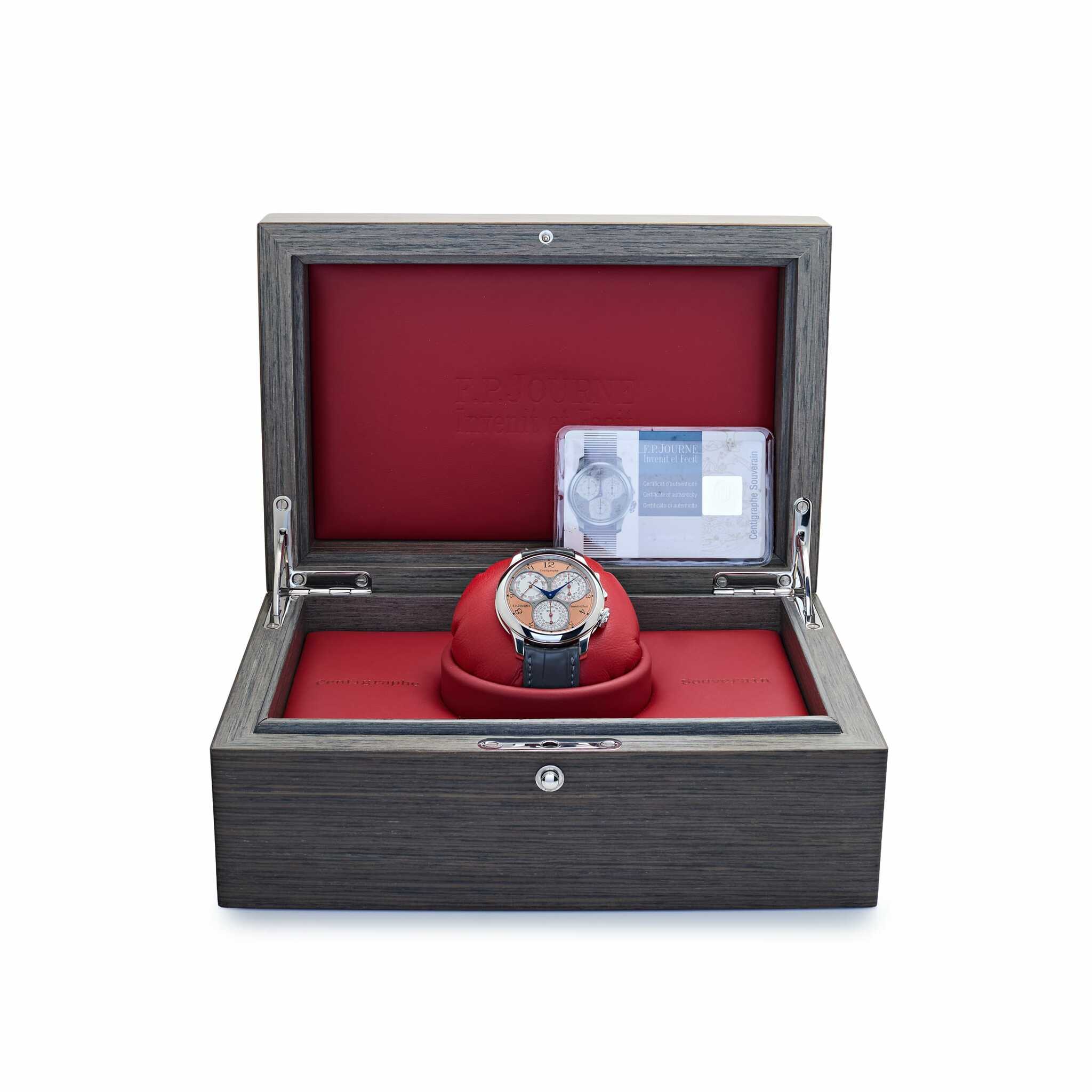
The Centigraphe Souverain is one of F.P. Journe's most animated and technically original chronographs, conceived to display extremely short elapsed times across three distinct registers. Its manually wound calibre 1506 separates the chronograph functions from conventional timekeeping in an ingenious architecture designed to preserve the amplitude of the balance while the chronograph is engaged. The unusual rocker set into the case band provides an equally distinctive means of starting, stopping and resetting the mechanism. In the present platinum configuration, the salmon dial softens the technical complexity with a warm, almost classical tone, creating a striking contrast between mechanical purpose and visual refinement. The three-register layout gives the dial a sense of constant motion, yet remains unmistakably Journe in its balance and typography. Examples combining a platinum case with this salmon dial are believed by scholars to have been produced in very small numbers, giving the present watch a rarity that is matched by the originality of the mechanism it contains.
The case architecture and unusual operating system give the watch a notably tactile quality, making the act of timing an important part of the experience of the piece. Journe's approach avoids the visual language of a conventional sports chronograph: the registers, typography and movement construction remain unmistakably those of an independent chronometer maker. The result is a chronograph that is technically assertive without sacrificing refinement, and whose appeal lies in the dialogue between mechanical ingenuity, compact proportions and the highly recognisable aesthetic codes developed by the manufacture.
Centigraphe Souverain The hand-wound movement measures elapsed times from one hundredth of a second to 10 minutes on three dials. The flyingseconds dial at 10 o'clock goes around in one second on a scale marked in hundredths of a second, making it theoretically possible to time an object moving at 360,000 km/h, or approximately 1/3000ths of the speed of light. One ingenious feature of the flying-seconds hand is that it can be stopped anywhere along its one-second journey around its dial, even between two 100th-second divisions, enabling an approximate fractional reading. On the dial at 2 o'clock, the hand revolves in 20 seconds around a time scale divided into seconds. The outer tachometer scale shows the speed against the odd seconds, while the inner scale corresponds to the even seconds. The third dial, at 6 o'clock, whose hand revolves in 10 minutes, has a similar tachometer scale with speeds corresponding to 20-second markers. The chronograph is started, stopped and zeroed by a rocker at 2 o'clock in the case band instead of the usual buttons on either side of the crown. This ergonomic solution has been patented. A second patent was granted for the ingenious configuration of the mechanism, which effectively isolates the chronograph from the timekeeping function. As a result, the amplitude of the balance is unaffected when the chronograph is running.
Examples such as this one featuring a platinum case and salmon dial were made in a very little series, scholars believe less than 15 examples were produced.