Antiquorum Auctioneers since 1974

Important collector's watches, wristw...

Hotel Richemond, Geneva, Apr 13, 2002

LOT 405

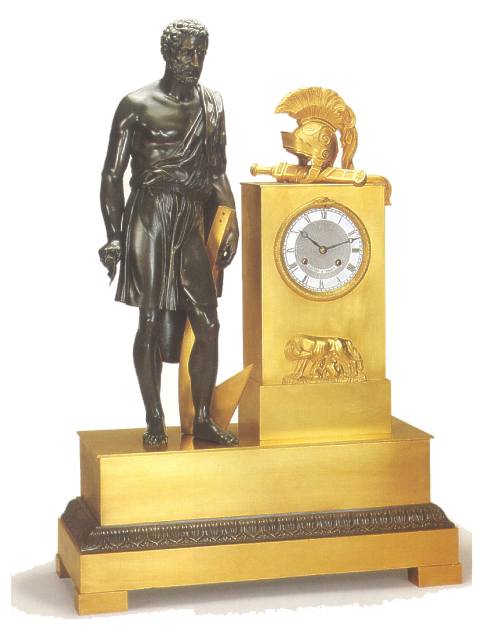
Romulus Ravrio a Paris, circa 1825. Very fine gilt brass mantel clock.

CHF 14,000 - 16,000

EUR 9,500 - 11,000 / USD 8,500 - 10,000

C. Rectangular base with square feet, molded patinated horizontal acanthus frame for rectangular stand supporting patinated statue of Romulus holding a scroll in one hand and a plow in another, a clock to the right with rectangular base supporting low relief plaque of Romulus and Remus being nursed by the she-wolf, dial within well formed bezel made of a snake biting its tail symbolizing the eternity of Rome, top with a sword in its scabbard and a great helm with panache. D. Silvered, champlevé Roman numerals, outer minute ring, engine turned center with winding apertures. M. Circular brass, full plate, going barrels, anchor escapement, silk cord suspension, short pendulum with round bob. Signed on dial, movement stamped ?T 202/5?. Dim. height 72 cm., width 47 cm.


LOADING IMAGES
Click to full view
Image

Grading System
Grade: AA

Very good

Case: 3

Good

Movement: 3*

Good

Overhaul recommended, at buyer's expense

Dial: 3-21-01

Good

Period

HANDS Original

Notes

Ravrio. Three generations of Paris bronze makers. Antoine-André Ravrio (b. Paris, 23 Oct. 1759; d. Paris, 4 Dec. 1814), among the best Parisian bronze makers and chasers of his period, was the son of a well-known bronze-founder, who trained him. He became Master in the bronze workers? guild in 1777 and in 1786 purchased the firm of Jean-Baptiste Disnematin-Dorat. Among the decorative items on Ravrio?s stock-lists were lamps, girandoles, clocks and bronze mounts that he supplied to leading cabinet-makers, such as George Jacob (ii) and Guillaume Beneman. He also collaborated with François Rémond. Ravrio?s career reached its peak in the Empire period and his work rivaled that of Pierre-Philippe Thomire. Ravrio was awarded a silver medal at the 1806 "Exposition de l?industrie" in Paris and in 1810 was appointed bronze worker to Napoleon, to work at the châteaux of Saint-Cloud, Compiègne and at the Tuileries. Ravrio?s adopted son, Louis Stanilas Lenoir (1783?1846) succeeded to his father.